
Science – Control and Coordination
Short Answer Type Questions
Q.1) How is the movement of leaves of the sensitive plants different from the movement of a shoot towards light?
Ans) Movement of leaves of the sensitive plants-
- It is not a growth movement.
- It is a nastic movement which does not depend on the direction of the stimulus.
Movement of leaves of a shoot towards light-
- It is a growth movement.
- It is a tropic movement which depends on the direction of the stimulus.
Q.2) Why are some patients of diabetes treated by giving injections of insulin?
Ans) Insulin is a hormone which is produced by the pancreas and helps in regulating blood sugar levels. If it is not secreted in proper amounts, the sugar level in the blood rises, causing many harmful effects. Hence, Insulin injections are given to diabetes patients, as a treatment.
Q.3) How does chemical coordination take place in animals?
Ans)The chemical co-ordination in animals takes place by the action of chemicals called hormones. They are produced in certain glands in very small amounts and added directly into the blood. They work on particular organs called target organs. They control and coordinate various functions of the body such as development, growth, sexual changes etc.
Q.4) Why is the use of iodised salt advisable?
Ans) Iodine is necessary for the thyroid gland to make thyroxin hormone. Thyroxin regulates carbohydrate, protein and fat metabolism in the body so as to provide the best balance for growth. Iodine is essential for the synthesis of thyroxin. In case iodine is deficient in our diet, it can cause a disease called goitre. One of the symptoms of this disease is a swollen neck.
Q.5) Write the main functions of auxins.
Ans) Functions of auxins are-
- It promotes cell enlargement and division.
- It initiates root formation on stem cuttings.
- Produces tropic plant responses like phototropism and geotropism.
- Controls plant growth.
- Prevents falling of leaves.
Q.6) Write the main functions of cytokinins.
Ans)Functions of cytokinins are-
- Cytokinins promote cell division and cell elongation.
- They help in promoting growth.
- Overcome seed dormancy of various types.
- Help in production of protein.
- Plant parts are formed by the effect of cytokinin.
Q.7) Draw a labelled diagram of the structure of neuron (nerve cell).
Ans)
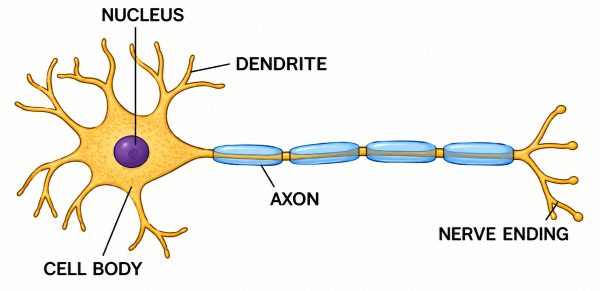
Structure of Neuron
Q.8) Write the names and two functions of hormones found in plants. Or
Write the names and functions of four plant hormones. Or
Write a function of each of the following plant hormones.
(i) Auxin, (ii) Gibberellins.
Ans) The hormones found in plants are auxin, cytokinin, gibberellin, abscisic acid. Their functions are as follows-
- Auxin – See Ans. to Q. No. 5.
- Cytokinins – See Ans. to Q. No. 6.
- Gibberellin
- Stimulate stem elongation and leaf expansion.
- They also promote seed germination and fruit growth.
- Abscisic acid
- Causes wilting of leaves and inhibits growth.
- Controls the process of opening and closing of flowers and leaves.
Q.9) How are involuntary actions and reflex actions different from each other?
Ans) Involuntary actions cannot be consciously controlled. For example, we cannot consciously control the movement of food in the alimentary canal. These actions are directly under the control of brain. Reflex actions, like closing of eyes when bright light is focussed show sudden response and do not involve any thinking. This means, brain is not involved in this. Reflex actions are controlled by spinal cord. Stimulus is not required in case of involuntary actions while it is required in case of reflex actions. All involuntary actions are reflex, but all reflex actions are not involuntary.
Q.10) Draw a labelled diagram of Human Brain. Ans. Labelled diagram of Human Brain
Ans)
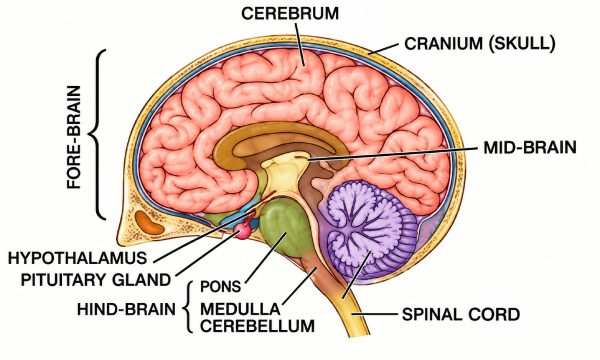
Human Brain
Q.11) Write any three functions of human brain.
Ans) Three main functions of human brain-
- To control and co-ordinate the functions of various sence organs.
- It is a centre of feelings, emotions, intelligence, memory etc.
- To control and co-ordinate the voluntary and involuntary actions.
Q.12) Write the name of any three endocrine glands find in human and also write its secreting hormone name.
Ans) The three endocrine glands and their secreting hormone-
| Endocrine Glands | Secreting Hormone |
|---|---|
| Endocrine gland | Secreting hormone |
| Thyroid Pancreas | Thyroxine Insulin |
| Adrenal | Adrenaline |
Q.13) Draw the structure of neuron and write any two names of organelles of any cell.
Ans) Refer Q. 7
Name of two cell organelles – (i) Mitochondria (ii) Golgibody.
Q.14) Draw the structure of reflex arc and write any two name of parts.
Ans)
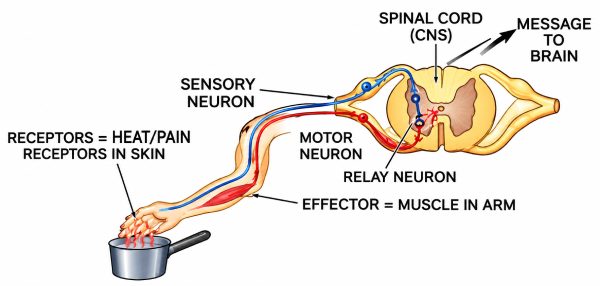
Reflex Arc