
Economics- Development
Short Answer Type Questions
Q.1) What is the main criterion used by the World Bank in classifying different countries? What are the limitations of this criterion, if any?
Ans) The criterion of per capita income is used by the World Bank in classifying different countries. Countries with a per capita income of US $ 49,300 per annum and above in 2019 are called rich countries, and those with a per capita income of US $ 2500 or less are called low-income countries. The biggest limitation of this criterion is that it does not tell us the correct distribution of income among the people in the country.
Q.2) Find out the present sources of energy that are used by the people in India. What could be the other possibilities fifty years from now?
Ans) The present sources of energy that are used by the people of India are:-
Conventional means of energy – Coal, petroleum, atomic energy, and hydropower energy are the conventional means.
Non-conventional means of energy – Solar energy, geothermal energy, tidal energy, wind energy, and biogas come in this category.
The other possibilities fifty years from now could be – Use of wind energy, solar energy, geothermal energy, biogas, and nuclear energy.
Q.3) “The earth has enough resources to meet the needs of all but not enough to satisfy the greed of even one person.” How is the statement relevant to the discussion of development? Discuss.
Ans) From the above statement, it is clear that to fulfill our needs, we have enough resources. But we are not satisfied because of our unlimited needs and desires. We are not satisfied with limited resources. This is the reason it is said that the earth is not enough to satisfy the greed of even one person. More and more production of goods and services is an indicator of development. The faster a nation produces goods and services, the faster the nation will develop.
Q.4) List a few examples of environment degradation that you may have observed around you.
Ans)
Q.5) What is sustainable development? What is its aim?
What is sustainable (continuous) development and explain its three objectives.
Ans) Sustainable Development-Sustainable development refers to such development in which proper attention is paid to the needs and interests of future generations while meeting the needs of the present generation.
The following are the main objectives of sustainable development:-
- The main object of sustainable development is to maximize the net benefits of economic activities.
- It is necessary that productive assets (physical, human, and environmental) stock should be preserved.
- A social security system should be provided to meet the basic needs of the poor.
Q.6) On the basis of which indicator of HDI ranking of Sri Lanka was better than India in 2019.
Ans) Gross national income per capita US dollars:-
| Sri Lanka | 12,707 |
| India | 6,681 |
Life expectancy at birth:-
| Sri Lanka | 77 |
| India | 69.7 |
Total enrollment ratio:-
| Sri Lanka | 10.6 |
| India | 6.5 |
Human Development Index (HDI) number in the world:-
| Sri Lanka | 73 |
| India | 130 |
Q.7) In the context of the sustainability of development, comment on renewable and non-renewable resources.
Ans) Renewable resources – Groundwater is an example of renewable resources. These resources are replenished by nature, as in the case of crops and plants. However, these resources may be overused. For example, in the case of groundwater, if we use more than what is being replenished by rain, then we would be overusing this resource.
Non-renewable resources – Non-renewable resources are those that will be exhausted after years of use. We have a fixed stock on earth which cannot be replenished. We do discover new resources that we did not know of earlier. New sources in this way add to the stock. However, over time, even this will get exhausted.
Q.8) What is the meaning of development? Describe any three characteristics of development.
Ans) Development refers to improving the well-being of people, which goes beyond just economic growth to also include aspects such as health, education, and freedom. Three characteristics of development are as follows:-
- The growth in the process of development varies from one person to the other depending on the health, genetic characters and the food they consume.
- Development is the continuous process that takes place regularly.
- Development follows the correct pattern in the growth as infancy to the death. It includes the stages of child, adolescence, maturity and the aged.
Q.9) Why are the countries of the middle east not called developed in spite of high per capita income?
Ans) Countries of the Middle East are not called developed because their performance on various indicators related to development is low. Some of the indicators are as follows:-
- There is no freedom of speech and expression in many countries.
- Women and men are not treated equally.
- There is a treatment for people belonging to one religion.
- There is a disparity among children.
- Health indicators are not good.
- Literacy levels are not good.
Q.10) What do you mean by public facilities?
Ans) Public amenities are basic facilities and services, such as clean water, healthcare, and public transportation, that are provided by the government to all citizens, often at a subsidized rate or for free. Some of the examples of Public Facilities which are necessary for development:-
- Healthcare: Government hospitals and dispensaries provide healthcare services.
- Water and Sanitation: Availability of safe drinking water and public toilet facilities.
- Education: Public schools and colleges that provide education to all children.
- Public Transport: Services like buses and trains that allow people to travel across different areas.
- Infrastructure: Roads, bridges, and electricity infrastructure that support economic and social activities.
- Food Security: Programs like the Public Distribution System (PDS) that ensure fair access to food grains.
Q.11) Describe the effort made by the government to improve the health of the people in India.
Ans) The efforts made by the government to improve the health of the people in India are as follows:-
- Improving the health condition of the people of the country has been the priority of the government.
- Our National Health Policy aims to improve access to health care, family welfare, and nutrition services, with special focus on the underprivileged sections of the population.
- Over the last five decades, India has developed a vast health infrastructure and manpower required for primary, secondary and tertiary health care in the public and private sectors.
- According to the National Health Policy 2013, there were 725 sub-centres, primary health centres, and community health centres in 1951, which increased to 181319 in 2013.
Q.12) Sustainable development is very essential support the state with argument.
Ans)
- Sustainable development must be maintained for future generations.
- Due to rapid economic development and industrialization, natural resources are being over-exploited, and there is a danger of these natural resources being completely exhausted.
- In the process of economic development, the environment is being damaged, which will ultimately affect humans.
- Anytime resources are used up they will be exhausted for example petroleum.
- Resources should be used wisely so that they can be used for development.
To achieve sustainable development we should use:-,
- Eco friendly technology
- Strictly comply with applicable environmental legislation.
Q.13) Explain the facts on which the standard of living depends.
Ans) The standard of living depends mainly on the following facts-
- Money and material goods
- Learning opportunity
- Position of personal honour in the family
- The presence of family members, friends and relatives
- Safe and fixed environment
- A good atmosphere at the workplace.
Q.14) What is national income? How is this different from per capita income?
Ans) The national income of a country is generally the sum of the value of all the goods and services produced in a year. National income is expressed in monetary terms. Therefore, to find the national income, the prices of all the goods and services produced are summed up, and the wear and tear of capital is deducted. In the end, whatever capital is left is called the national income of that country. If the sum of this amount is divided by the sum of the total population of that country, then the per capita income of that country will be known.
Q.15) Define per capita income, and state two reasons for the low per capita income in India.
Ans) Per Capita Income – The average income of individuals in a country in a year is called per capita income of that nation. This assumption is also related to the measurement of income at current prices and at constant prices. For example, if the per capita income of the year 2010 is to be found at current prices, then the national income of that year is divided by the population of that year.
Per Capita Income = National Income/ Population
The reasons for low per capita income – (i) an increase in population, (ii) uncertainty of agricultural production.
Q.16) Apart from income, express any three parts that are important for our life.
Ans) Three parts that are important for our life are as follows:-
- Infant Mortality Rate – Refer Que No – 5 (very short)
- Literacy Rate – Refer Que No – 6 (very short)
- Life Expectancy at birth – Refer Que No – 8 (very short)
Q.17) What do you mean by economic development?
Ans) Meaning of Economic Development and Definition-Economic development is a continuous process under which all possible efforts are made for the economic, social, and industrial development of the nation and the available resources of the nation are exploited to the maximum possibility. As a result of these efforts, long-term growth in the real national income and per capita income of the nation becomes possible. Economists have defined it keeping in mind the different bases of development.
According to Meyer and Baldwin, “Economic development is a process in which the real national income of an economy increases in the long run.”
According to Colin Clark, “Economic development refers to the process in which the increased capital requirement brings about an increase in per capita income to a certain extent.”
In short, economic development means a better life and a higher standard of living. It not only protects our life but also increases the value of life.
Q.18) Briefly describe the groundwater crisis in India.
Ans) The evidence suggests that the groundwater is under serious threat of overuse in many parts of the country. About 300 districts have reported a water level decline of over 4 metres during the past 20 years. Nearly one-third of the country is overusing their groundwater reserves. In another 25 years, 60 per cent of the country would be doing the same if the present way of using this resource continues. Groundwater overuse is particularly found in the agriculturally prosperous regions of Punjab and Western U.P., hard rock plateau areas of central and South India, some coastal areas, and the rapidly growing urban settlements.
Q.19) Explain how the topic of sustainability is important for development.
Ans) Stability is important for development because of the following reasons:-
- Sustainable development aims that development should meet the needs of the present without compromising the ability of future generations to meet their needs.
- Reckless exploitation and overuse of resources should be banned.
- Sustainability involves the judicious use of resources and maintains ecological balance.
- Sustainability lays emphasis on establishing the protection of the environment and checks environmental degradation.
Q.20) What is the main criterion used by the World Bank in classifying different countries? What are the limitations of this criterion, if any?
Ans) The criterion of per capita income is used by the World Bank in classifying different countries. Countries with per capita income of US $ 49,300 per annum and above in 2019, are called rich countries and those with per capita income of US $ 2500 or less are called low income countries. The biggest limitation of this criterion is that it does not tell us the correct distribution of income among the people in the country.
Q.21) In what respects is the criterion used by the UNDP for measuring development different from the one used by the world bank?
Ans) Human Development Report published by UNDP compares countries based on the educational levels of the people, their health status and per capita income where as the criterion of World Bank is based on per capita income.
Q.22) Why do we use averages? Are there any limitations to their use? Illustrate with your own examples related to development.
Ans) . For comparison between countries, total income is not such a useful measure. Since countries have different populations, comparing total income will not tell us what an average person is likely to earn ? Are people in one country better off than others in a different country? Hence, we compare the average income which is the total income of the country divided by its total population.
For example, let us consider two countries, A and B. For the sake of simplicity, we have assumed that they have only 5 citizens each. Based on the data given below, the average income for both countries is calculated.
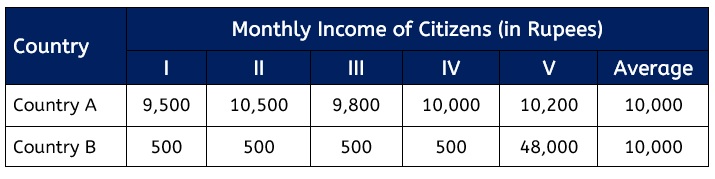
It is clear from the table, perhaps some of us may like to live in country B if we are assumed to be its fifth citizen, but if it is a lottery that decides our citizenship number, then perhaps most of us will prefer to live in country A. It is because even though both countries have identical average income, Country A is preferred because it has a more equitable distribution. In this country, people are neither very rich nor extremely poor. On the other hand, most citizens in country B are poor, and one person is extremely rich. Hence, while average income is useful for comparison, it does not tell us how this income is distributed among people.
Q.23) Kerala, with lower per capita income has a better human development ranking than Haryana. Hence, per capita income is not a useful criterion at all and should not be used to compare states. Do you agree? Discuss.
Ans) Discussion:-
- In 2018-19, the per capita income of Haryana was 2,36,147, whereas in Kerala it was 2,04,105.
- In 2017-18, as per the census, the literacy rate of Haryana was 82% and Kerala’s literacy rate was 94%. The literacy rate is higher in Kerala.
- In 2018, the infant Mortality Rate per 1,000 live births was 30, whereas in Kerala it was 7.
- Net attendance Ratio (per 100 persons) of the age group 14 and 15 in Haryana was 61, whereas in Kerala it was 83.
It is clear from the above comparisons that, inspite of less per capita income in Kerala, its human development is better than Haryana because as compared to Kerala has more facilities of human development. Therefore per capita income is not a useful criterion and Human Development Index, is useful for comparative study in context of development of states.
Q.24) Find out the present sources of energy that are used by the people in India. What could be the other possibilities fifty years from now?
Ans) The present sources of energy that are used by the people of India are:-
Conventional means of energy – Coal, petroleum, atomic energy, and hydropower energy are the conventional means.
Non-conventional means of energy – Solar energy, geothermal energy, tidal energy, wind energy and biogas come in this category.
The other possibilities fifty years from now could be – Use of wind energy, solar energy, geothermal energy, biogas, and nuclear energy.
Q.26) Why is the issue of sustainability important for development?
Ans) The essence of sustainable development is that the resources spent in the development process are met so that in the future also they are also available for resource development in the same way as they have been available earlier.