
Economics- Development
Long Answers Type Questions
Q.1) Why do we use averages? Are there any limitations to using their use? Illustrate with your own examples related to development.
Ans) For comparison between countries, total income is not such a useful measure. Since countries have different populations, comparing total income will not tell us the earning of an average person. To know whether the people of one country are better off than those who are in a different country, we compare the average income, which is the total income of the country divided by its total population.
For example, let us consider two countries, A and B. For the sake of simplicity. we have assumed that they have only 5 citizens each. Based on the data given below, the average income for both countries is calculated.
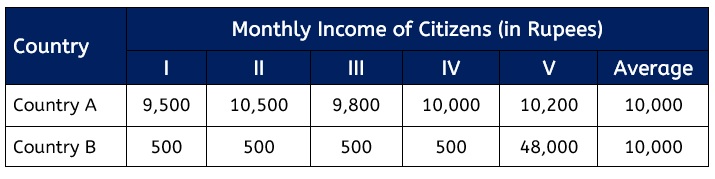
It is clear from the table, perhaps some of us may like to live in country B if we are assumed of being its fifth citizen, but if it is a lottery that decides our citizenship number, then perhaps most of us will prefer to live in country A. It is because even though both countries have identical average income, Country A is preferred because it has more equitable distribution. In this country, people are neither very rich nor extremely poor. On the other hand, most citizens in country B are poor, and one person is extremely rich. Hence, while average income is useful for comparison but it does not tell us how this income is distributed among people.
Q.2) Kerala, with lower per capita income has a better human development ranking than Haryana. Hence, per capita income is not a useful criterion at all and should not be used to compare states. Do you agree? Discuss.
Ans) Discuss:-
- In 2018-19, the per capita income of Haryana was ₹ 2,36,147, whereas in Kerala it was ₹ 2,04,105.
- In 2017-18, as per the census, the literacy rate of Haryana was 82% and Kerala’s literacy rate was 94%. Literacy rate is higher in Kerala.
- In 2018, the Infant Mortality Rate per 10,000 live births was 30 whereas in Kerala it was 7.
- Net attendance Ratio (per 100 persons) of age group 14 and 15 in Haryana was 61 whereas in Kerala it was 83.
It is clear from the above comparisons that inspite of less per capita income in Kerala, its human development is better than Haryana because as compared to Haryana, Kerala has more facilities of human development. Therefore, per capita income is not a useful criterion, and the human development index is useful for comparative study in the context of the development of states.
Q.3) Write the need and importance of economic development.
Explain the importance of economic development in the interest of the country on the basis of any five points.
Ans) Need and Importance of Economic Development The importance of economic development of a nation are as follows-
- Economic Achievements – The economy receives many economic benefits as a result of the process of economic development, for example, an increase in national production, capital formation, freedom from business cycles, i.e., economic stability, equitable and justified distribution of the means of production, prevention of competitive wastage, fair distribution of national income, and exploitation of natural resources etc.
- Reduction in Economic Inequality – The presence of economic inequality is considered unfair from the point of view of social justice. The main goal of planned economic development is to eliminate economic inequality. Thus, with economic development, the distribution of wealth becomes possible in an equitable and justified manner.
- Increase in Employment Opportunities – In the process of economic development, there is a wide expansion and development of structural industries in the nation, due to which the people start getting employment opportunities and the problem of unemployment starts getting resolved.
- Control on Natural Calamities – In ancient times, human beings suffered from natural disasters, for example, floods, drought, epidemics, earthquakes, etc. had to be faced, but now, as a result of economic development, man has conquered many disasters.
- Improvement in Standard of Living and Help in Eradicating Poverty – In the process of economic development, along with the increase in national income, the monetary income of the people increases, due to which their purchasing power increases and the standard of living improves. People lead a more comfortable life.
Q.4) Define sustainability of development. Explain its main characteristics.
Sustainable development is defined as development that meets the needs of the present without compromising the ability of future generations to meet their own needs. It involves finding a balance between economic growth, social equity, and environmental protection by using resources judiciously and minimising damage to nature. Its key aspects include responsible use of resources, protecting ecosystems, promoting social welfare, and turning to renewable energy sources to ensure the long-term survival of all.
The concept of sustainable development was first introduced in the world conservation strategy presented in 1980 by the International Union for Conservation of Nature and Natural Resources. “Sustainable development was defined in the World Commission on Environment and Development’s 1987 Brundtland report ‘Our Common Future’ as development that meets the needs of the present without compromising the ability of future generations to meet their own needs.”
Characteristics of Sustainable Development are as follows-
- The number of poor should not be increased.
- The income distribution should not decrease.
- The needs of the present generation should be met in such a way that the ability of future generations to meet their own needs is not adversely affected.
- The resource base of the country is maintained continuously.
- The quality of environmental factors-air, water, and land should be maintained continuously, and these represent the collective legacy of present and future generations.
Q.5) What do you understand by the Human Development Index? Explain the components of the formation of Human Development Indicators.
Explain the meaning of Human development Index and its components.
Explain the Human Development Indicator as an indicator of economic development.
Ans) Human Development Index (HDI) – Mahbub al-Haq, an economist associated with the United Nations Development Program (UNDP), was the first to attempt to develop a universal indicator of development. On his suggestion, a group of economists led by Nobel-Prize-winning Indian economist Prof. Amartya Sen and Prof Singer Hans developed the Human Development Index (HDI).
The concept of HDI is based on the assumption that the people living in the nation are the real wealth of that nation. Basic objectives of economic development is to create an environment in which people can enjoy long, healthy, and creative lives. According to these evolutionary economists, national income and its growth is not a true indicator of economic development.
Human development is the only goal of human beings and is the best measure of economic development, because, despite being useful in many respects, the data related to national income does not throw light on the structure of national income and the people who are actually benefiting from it. According to the Human Development Report. Human development is the process of broadening the preferences of people. These likes may be many, and these preferences may change over time.There are three essential things at every stage of development (1) Desire to live a long and healthy life. (2) The desire to acquire knowledge. (3) The desire to have access to the resources necessary to lead a good life. According to the economists, if these three things are not available, then human beings will be deprived of many other opportunities.
The HDI is a composite indicator of three social indicators, taking into account the real GDP per capita. The following three indicators are taken to calculate the value of HDI of a nation:-
- A Longevity-Age is measured in terms of life expectancy at birth, which is shown as minimum of 25 years and maximum 85 years.
- Achievement of Educational Qualifications-It is measured as a mixture of adult education (two-thirds weight) and proportions of attendance in primary, secondary and regional schools (one third weighing).
- Standard of Living The standard of living is measured in terms of real GDP per capita (purchasing power parity in dollars). Before estimating the Human Development Index, different dimensional indices are calculated in all three areas. (i) life expectancy at birth, (ii) literacy rate, (ii) GDP per capita, each variable in its calculation (item) to “nil’ and ‘one’ is placed in the middle of the scale. Every nation falls at some point on this scale.