
Science – How do Organism Reproduce?
Long Answer Type Questions
Q.1) Define reproduction. How does it help in providing stability to the population of species?
Ans) Reproduction is the biological process of the production of new individual organisms or offsprings from their parents. The reproduction may be asexual or sexual in plants and sexual in human beings. In the absence of reproduction one particular species will disappear with time. organisms of a species by giving birth to new individuals as the rate of birth must be at par with the rate of death to provide stability to a population of species.
Q.2) Explain the term regeneration as used in relation to reproduction of organisms. Describe briefly how regeneration is carried out in multicellular organisms like Hydra.
Ans) The process of growing an entire organism from a single cell or group of cells is called regeneration. Many organisms give rise to a new individual organism from their body parts. That is, if the individual is somehow cut or broken into many pieces, many of these pieces grow into separate individuals. For example, simple animals like Hydra and Planaria can be cut into any number of pieces and each piece grows into a complete organism. This is known as regeneration. Regeneration is carried out by specialised cells. These cells proliferate and make large number of cells.
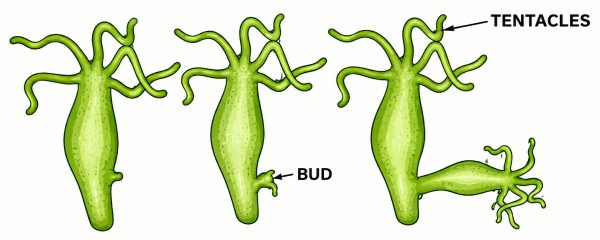
Budding in Hydra
Organisms such as Hydra use regenerative cells for reproduction in the process of budding. In Hydra a bud develops as an outgrowth due to repeated cell division at one specific site. Those buds develop into tiny individuals, and when fully mature, detach from the parent body and become new independent individuals.
Q.3) List three techniques that have been developed to prevent pregnancy. Which one of these techniques is not meant for males? How does the use of these techniques have a direct impact on the health and prosperity of a family?
Ans) The three techniques developed to prevent pregnancy are use of condoms, oral contraceptive pills and placement of contraceptive devices such as Copper-T in the uterus. Among the above techniques, use of oral contraceptive pills which are drugs that change the hormonal balance so that eggs are not released and placement of contraceptive devices, such as copper-T in the uterus are not meant for males.
Use of the techniques to prevent pregnancy will help in family planning. This will be helpful in enhancing the prosperity of the family. Birth of a child demands care, responsibility, and it affects the family economically also. If there will be less income and more mouths to feed, there will be economic burden on the family. Apart from it, pregnancy makes a major impact on the body and mind of the woman. If she is not ready for it, her health will be adversely affected.
Q.4) (a) Name the human male reproduction organ that forms sperms and also secretes a hormone. Write the functions of the secreted hormone.
(b) Name the parts of human female reproductive system where-
- Fertilization takes place.
- Implantation of the fertilized egg occurs.
Explain how the embryo gets nourishment inside the mother’s body.
Ans) (a) The formation of sperms in males takes place in the testes which also secretes a hormone called testosterone.
Functions of testosterone (i) Regulates the formation of sperms in the testes. (ii) Brings about changes in the appearance seen in boys at the time of puberty. It is responsible for secondary sexual characteristics in males.
(b) (i) Fertilisation in females takes place in the oviduct or fallopian tube. (ii) The implantation of the fertilised egg occurs in the lining of the uterus, where it continues to grow and develop organs to become foetus.
After fertilisation, the lining of the uterus thickens and is richly supplied with blood to nourish the growing embryo. The embryo gets nutrition from the mother’s blood with the help of a special tissue called placenta. It is a disc embedded in the uterine wall. Placenta contains villi on the embryo’s side of the tissue and blood spaces on mother’s side surrounding the villi. This provides a large surface area for glucose and oxygen to pass from the mother to the embryo. The waste substances generated by embryo are removed by transferring into mother’s blood through placenta.
Q.5) List six specific characteristics of sexual reproduction.
Ans) Specific characteristics of sexual reproduction are as follows: –
- In sexual reproduction, both male and female parents are involved.
- Fully-developed reproductive parts are present in it. eg. secondary sexual characteristics appear in humans at puberty and apperance of stamen and pistil in plants.
- It occurs in higher plants and animals.
- It involves fertilisation or fusion of male and female gametes, giving rise to zygote.
- Characteristics of both the parents are inherited in the developing embryo.
- Parents remain alive after the process of reproduction.
Q.6) (a) Draw in sequence, different stages of binary fission in Amoeba.
(b) What is vegetative propagation?
Ans) (a) Sequence, different stages of Binary fission in Amoeba
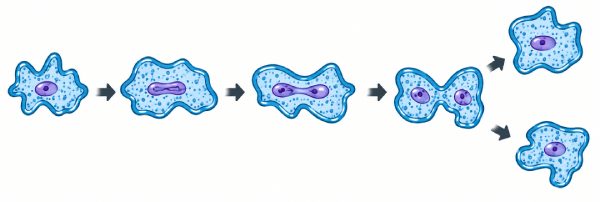
Binary fission in Amoeba
(b) See Short Answer Type Q. No. 4.