
Science – How do Organism Reproduce?
Short Answer Type Questions
Q.1) What is the importance of DNA copying in reproduction?
Ans) DNA is the genetic material present in the cells of all organisms. The genetic information from generation to generation is carried by DNA. It is therefore possible for the organism to produce organism of its own type due to DNA copying only. For the inheritance of traits of the parent, DNA copying is a must. DNA copying also brings about variation, which forms the basis for the origin of new species.
Q.2) Why is variation beneficial to species but not necessarily for the individual?
Ans) Variations are beneficial to the species than the individual, because sometimes, for a species, the environmental conditions change so drastically that their survival becomes difficult. Eg. if temperature of water increases suddenly, then most bacteria living in water would die. Only a few variants that are resistant to heat would be able to survive. If these variants were not there, then the entire species of bacteria would have been destroyed. Thus, these variants help in the survival of species. However, all variations are not beneficial for the individual organisms.
Q.3) Reproduction is one of the most important characteristics of living beings.’ Give three reasons in support of the statement.
Ans) Reproduction is an important characteristic of living beings because:-
- It is through reproduction that organisms create new individuals that look very much like themselves.
- A species will be lost if it will not reproduce. Genital inheritance occurs due to reproduction. Reproduction is linked to the stability of population of species.
- There is some variation in the newly formed species during reproduction. The in-built tendency for variation during reproduction is the basis for evolution.
Q.4) What is vegetative propagation? State two advantages and two disadvantages of this method.
Ans) The method of reproduction in which a new plant is grown from a plant part such as root, stem or leaves is called vegetative propagation; Example-rose, sugarcane etc. Advantages: –
- Plants raised by vegetative propagation can bear flowers and fruits earlier than those produced from seeds.
- All plants produced are genetically similar to the parent plant to have all its characteristics.
- It makes possible the propagation of plants that have lost the capacity to produce seeds like, banana, orange, rose and jasmine.
Disadvantages:-
- There is no genetic variation in plants.
- Plants are prone to diseases that are specific to the species.
Q.5) How is the process of pollination different from fertilization?
Ans) Pollination is the process of transfer of pollens from anther to stigma of the same or different flower(s). It occurs with the help of certain pollinators such as air, water, birds or insects. Fertilization is the fusion or male and female gametes. It occurs inside the ovule and leads to the formation of zygote.
Q.6) Draw a labelled diagram of the longitudinal section of a flower.
Ans)
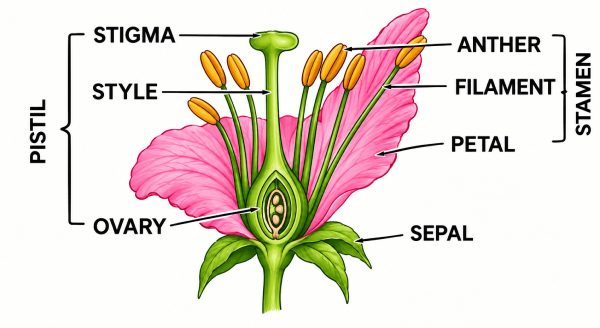
section of a flower
Q.7) How does reproduction help in providing stability to populations of species? Or
Why is reproduction essential?
Ans) Living organism reproduce for a containuation of a particular species. It helps in providing stability to the population of species by producing a new individual that resembles the parents. This is the reason why cats give birth to only cats or dogs give birth to only dogs. Therefore, reproduction provides stability to populations of dogs or cats or any other species.
Q.8) Define self pollination.
Ans) The self pollination – “When the pollination occurs in the same flower then this pollination is called self pollination i.e., if the pollen grains from the anther of one flower transfer to the stigma of the same flower then this process is called self- pollination.”
Q.9) How does embryo get nourishment inside the mother’s body?
Ans) The embryo gets nourishment inside the mother’s body from the blood of mother. For this purpose a specific tissue known as placenta is developed which provide glucose, oxygen and other material required to the embryo from the mother’s body.
Q.10) Why is vegetative propagation practised for growing some types of plants?
Ans) Some plants have the capacity to reproduce new ones from their vegetative parts such as roots, stem or leaves asexually. In this process the new plants are produced easily and early. By this process such plants can reproduce new plants which do not have capacity of producing seeds. The plants which are reproduced by this process are identical to their parent plants in all respect. This process is called vegetative propagation. Therefore, the vegetative propagation practised for growing some types of plants.