
Science – Metals and Non Metals
Short Answer Type Questions
Q.1) Explain the meanings of “malleable” and “ductile.”
Ans) Malleable – Substances that can be beaten into thin sheets are called malleable. For example, most of the metals are malleable, gold and silver are the most malleable metals. This property is called malleability.
Ductile – Substances that can be drawn into thin wires are called ductile. Most of the metals are ductile. Gold is the most ductile metal.
Q.2) Why is sodium kept immersed in kerosene oil?
Ans) Sodium is a highly reactive metal. If it is kept in open, it can explosively react with oxygen present in air to catch fire. Hence to prevent accidental fires, it is kept immersed in kerosene oil.
Q.3) Which gas is produced when dilute hydrochloric acid is added to a reactive metal? Write the chemical equation when iron reacts with dilute H₂SO₄.
Ans) Hydrogen gas is produced when dilute hydrochloric acid is added to a reactive metal. When iron reacts with dilute H₂SO₄, a green-colored solution of iron (II) sulphate is formed with the evolution of Hydrogen gas.
Fe(s) + H₂SO₄ → FeSO₄ (aq) + H₂(g)
Q.4) What would you observe when zinc is added to a solution of iron II sulphate? Write the chemical reaction that takes place.
Ans) When zinc is added to iron (II) sulphate then it will displace iron from iron sulphate solution.
Zn(s) + FeSO₄(aq) → ZnSO₄(aq) + Fe(s)
Q.5) Why do ionic compounds have high melting points?
Ans) Ionic compounds have strong electrostatic forces of attraction between the ions. Therefore, a considerable amount of energy is required to break these forces. That is why. ionic compounds have high melting points.
Q.6) Define the following terms:
- Mineral
- Gangue
- Ore
- Sonorous
Ans) (i). Mineral – The elements or compounds, which occur naturally in the earth’s crust, are known as minerals.
(ii). Ore – Minerals which contain a high percentage of a particular metal and from which the metal can be extracted profitably are known as ores.
(iii). Gangue –The impurities present in the ore such as sand, rocks etc. are known as gangue.
(iv). Sonorous –“The metal produce a characteristic sound when they are beaten or collide with other hard substance. The metals are called sonorous and this property is called sonority.
Q.7) What are alloys?
Ans) An alloy is a homogenous mixture of two or more metals or a metal and a non-metal. Example – Steel is an alloy of carbon and iron.
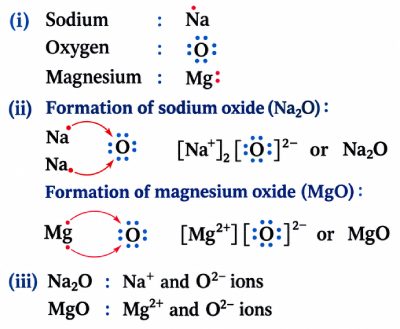
Q.8) (i). Write the electron-dot structures for sodium, oxygen and magnesium.
(ii). Show the formation of Na₂O and MgO by the transfer of electrons.
(iii) What are the ions present in these compounds?
Ans) (i). The representation of elements with valence electrons as dots around the elements is referred as electron-dot structure for elements.
Q.9) You must have seen tarnished copper vessels being cleaned with lemon or tamarind juice. Explain why these sour substances are effective in cleaning the vessels.
Ans) Copper reacts with moist carbon dioxide in air to form copper carbonate and as a result, copper vessel loses its shiny brown surface forming a green layer of copper carbonate. The citric acid present in lemon or tamarind neutralises basic copper carbonate and dissolves the layer. That is why, tarnished copper vessels are cleaned with lemon or tamarind juice to give the surface of copper vessel its characteristic lustre.
Q.10) Give reason why copper is used to make hot water tanks and not steel (an alloy of iron).
Ans) Copper does not react with cold water, hot water, or steam. However, iron reacts with steam. If the hot water tanks are made of steel (an alloy of iron), then iron would react vigorously with the steam formed from hot water.
3Fe + 4H₂O → Fe₃O₄ + H₂O