
Science – Life Processes
Long Answer Type Questions
Q.1) What are the differences between autotrophic nutrition and heterotrophic nutrition? Or
Write the difference between autotropic nutrition and heterotropic nutrition.
Ans) Difference between autotropic nutrition and heterotropic nutrition: –
| Autotrophic Nutrition | Heterotrophic Nutrition |
|---|---|
| Food is synthesised from simple inorganic raw materials such as CO2 and water. | Food is obtained directly or indirectly from autotrophs. This food is broken down with the help of enzymes. |
| Chlorophyll is required. | Chlorophyll is not required. |
| Food is generally prepared during the day. | Food can be obtained at any time. |
| All green plants and some bacteria have this type of nutrition. | All animals and fungi have this type of nutrition. |
Q.2) Write the differences between xylem and phloem. (Any four) Differences between xylem and phloem
Ans) Differences between xylem and phloem: –
| Xylem | phloem |
|---|---|
| Xylem transports water and minerals absorbed by root to leaves. | Phloem transports food material prepared by leaves to various parts of the plant. |
| These are dead tissues. | These are living tissues. |
| These tissues contain conducting tubules. | These tissues contain sieve tubes. |
| Their walls are very thick. | Their walls are less thick. |
Q.3) How are water and minerals transported in plants? Or
What are the components of the transport system in plants and how are water and minerals transported in plants?
Ans) The components of the transport system in plants are xylem and phloem. Water and minerals are transported through xylem cells from soil to the leaves. The xylem cells of roots, stem and leaves are interconnected to form a conducting channel that reaches all parts of the plant. The root cells take ions from the soil. This creates a difference in the concentration of these ions between the root and the soil. Thus there is a steady movement of water into root xylem, creating a column of water that is steadily pushed upwards. An osmotic pressure is formed and water and minerals are transported from one cell to the other due to osmosis. A continuous loss of water takes place from leaves due to evaporation of water molecules or transpiration. Thus, a suction pressure is created due to which water is forced into the xylem cells of roots. The effect of root pressure in transport of water is more important at night. During the day, the transpirational pull becomes the major driving force in the movement of water in the xylem.
Q.4) What are the different ways in which glucose is oxidised to provide energy in various organisms?
Ans) In various organisms, the first step in the oxidation of glucose (a six-carbon molecule) is its breakdown into a three-carbon molecule called pyruvate. Further breakdown of pyruvate takes place in different manners in different organisms.
Anaerobic Respiration – This process takes place in the absence of oxygen, e.g. in yeast during fermentation. In this case, pyruvate is converted into ethanol and carbon dioxide.
Aerobic Respiration – In aerobic respiration, the breakdown of pyruvate takes place in presence of oxygen to give rise to three molecules of carbon dioxide and water. The release of energy in aerobic respiration is quite more than anaerobic respiration.
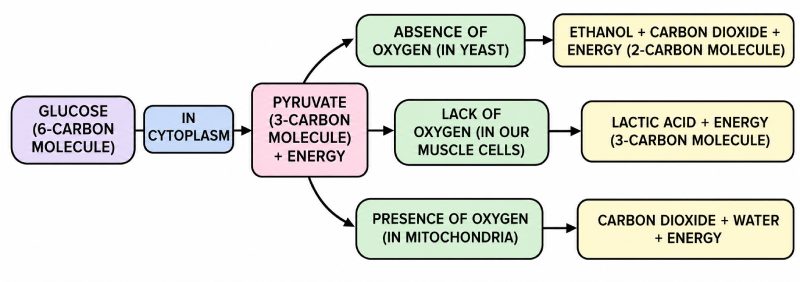
Breakdown of glucose by various pathway
Lack of Oxygen – Sometimes, when there is lack of oxygen, especially during vigorous activity, in our muscles, pyruvate is converted into lactic acid (3-carbon molecule compound) Formation of lactic acid in muscles causes cramps.
Q.5) Describe the structure and functioning of nephrons (with diagram).
Ans) Nephrons are the basic filtering units of kidneys. Each kidney has large number The Foreg of nephrons packed close together. The main components of the nephron are glomerulus, Bowman’s capsule, and a long renal tubule.
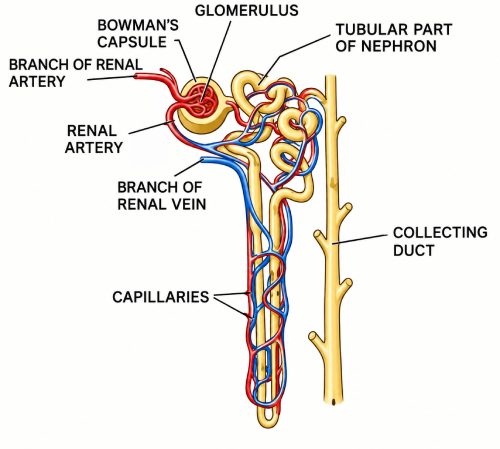
Structure of Nephron
Functioning of a nephron: –
- The blood enters the kidney through the renal artery, which branches into many capillaries associated with glomerulus.
- The water and solute are transferred to the nephron at Bowman’s capsule.
- Some substances in the initial filtrate, such as glucose, amino acids, salts and a major amount of water, are selectively re-absorbed as the urine flows along the Bowman’s capsule.
- The filtrate then moves down into the loop of Henle, where more water is absorbed.
- From here, the filtrate moves upwards into the distal tubule and finally to the collecting duct. Collecting duct collects urine from many nephrons.
- The urine formed in each kidney enters a long tube, the ureter, which connects the kidneys with the urinary bladder. Urine is stored in the urinary bladder until the pressure of the expanded bladder leads to the urge to pass it out through the urethra.
Q.6) What are the differences between aerobic and anaerobic respiration? Name some organisms that use the anaerobic mode of respiration.
Ans) Differences between aerobic and anaerobic respiration: –
| Aerobic Respiration | Anaerobic Respiration |
|---|---|
| It takes place in the presence of oxygen. | It takes place in the absence of oxygen. |
| It occurs in cytoplasm and mitochondria. | It occurs only in cytoplasm. |
| In it, there is complete oxidation of glucose. | There is incomplete oxidation of glucose in it. |
| In it, CO₂ and water vapour are formed. | End products vary. |
| Energy is released in large amount. | Energy is released in small amount. |
| It involves the exchange of gases between the organism and the outside environment. | Exchange of gases is absent. |
Lactic and bacteria, E. Coli and yeast etc. undergo anaerobic mode of respiration.
Q.7) Compare the functioning of alveoli in the lungs and nephrons in the kidneys with respect to their structure and functioning.
Ans) Structure and Function are: –
| Alveoli | Nephrons |
|---|---|
| Structure | Structure |
| Alveoli are tiny balloon-like structures present inside the lungs. | Nephrons are tubular structures present inside the kidneys. |
| The walls of the alveoli are one celled thick and contain an extensive network of blood capillaries. | Nephrons consist of a glomerulus, Bowman’s capsule, and a long renal tube. |
| Function | Function |
| Alveoli are the site of gaseous Nephrons are the basic filteration exchange. unit. | The blood enters the kidney through the renal artery. |
| The blood brings carbon dioxide from the rest of the body for release in to the alveoli, and the oxygen in the alveolar air is taken up by blood in the alveolar blood vessels to be transported to all the cells in the body. | The nitrogenous waste such as urea or uric acid are removed from blood through nephrons. The nitrogenous waste in the form of urine is collected by collecting duct. |
Q.8) Write the differences between blood and lymph. Or
Write the differences between blood and lymph. (Any two) Differences between blood and lymph.
Ans)
| Blood | Lymph |
|---|---|
| Blood is a red coloured fluid connective tissue. | Lymph is a colourless fluid connective tissue. |
| It contains more protein. | It contains less protein. |
| It contains blood corpuscles. | It does not contain blood corpuscles |
| In it, excretory substances are found in less amount. | In it, excretory substances are found in greater amount. |
Q.9) Draw a neat and clean labelled diagram of human digestive system.
Ans) Labelled diagram of human digestive system-
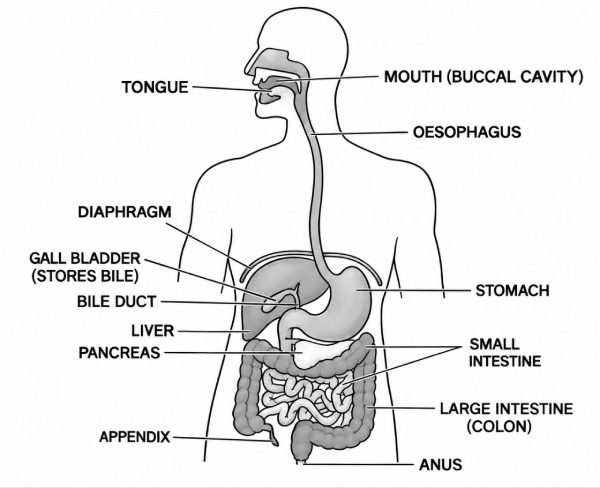
Human Digestive System
Q.10) Draw a neat and clean labelled diagram of human heart.
Ans) Labelled diagram of human heart-
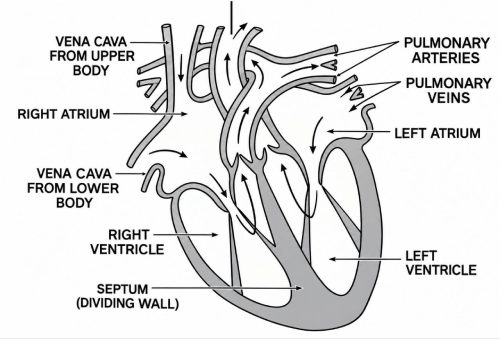
Human Heart
Q.11) Draw a labelled diagram of open and closed stomatal pore.
Ans) Labelled diagram of open and closed stomatal pore-
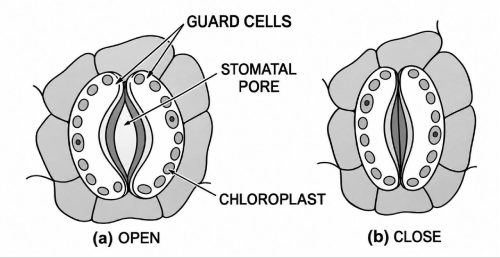
Open and Closed Stomatal Pore