
Science – Life Processes
Short Answer Type Questions
Q.1) What would be the consequences of deficiency of haemoglobin in our bodies?
Ans) Haemoglobin is the respiratory pigment that transports oxygen to the body cells r cellular respiration. Therefore, deficiency of haemoglobin in blood can affect the oxygen supplying capacity of blood. This can lead to deficiency of oxygen in the body cells. It can also lead to a disease called anaemia.
Q.2) What are the components of the transport system in human beings? What are the functions of these components?
Ans) The main components of the transport system in human beings are the heart, the blood and the blood vessels.
Functions:
- Heart – Heart pumps oxygenated blood throughout the body. It receives deoxygenated blood from various body parts and sends this impure blood to the lungs for oxygenation.
- Blood – It helps in the transport of oxygen, nutrients, and excretion of CO₂ and nitrogenous wastes.
- Blood Vessels (arteries, veins and capillaries) – They carry blood either away from the heart to various organs or from various organs back to the heart.
Q.3) How are the lungs designed in human beings to maximize the area for exchange of gases?
Ans) Lungs contain several balloon-like structures called alveoli, which provide surface for the exchange of gases. The walls of the alveoli contain an extensive network of blood vessels. When we breathe in, we lift our ribs and flatten our diaphragm, and thus the chest cavity becomes larger. Because of this, air is sucked into the lungs and fills the expanded alveoli. The blood brings CO₂ from the rest of the body for release into the alveoli and the oxygen in the alveolar air is taken up by the blood in alveolar blood vessels to be transported to all the cells in the body.
Q.4) Draw a well labelled diagram of the human excretory system.
Ans)
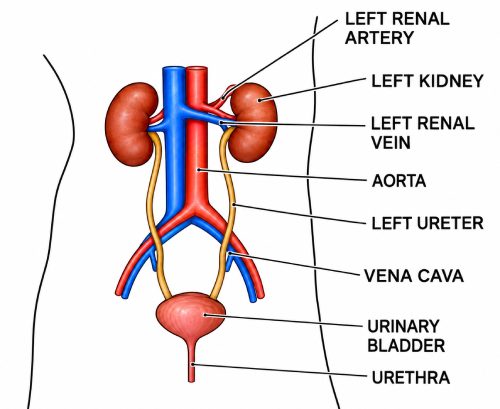
Excretory system in human beings