
Science – Carbon and its Compounds
Short Answer Type Questions
Q.1) Why are carbon and its compounds used as fuels for most applications?
Ans) Carbon and its compounds give large amount of heat on combustion due to high percentage of carbon and hydrogen. Carbon compounds used as fuel have optimum ignition temperature with high calorific values and are easy to handle. Their combustion can be controlled. Therefore, they are used as fuels.
Q.2) Explain the formation of scum when hard water is treated with soap.
Ans) Hard water often contains salts of calcium and magnesium. Soap molecules react with the salts of calcium and magnesium and form a precipitate. This precipitate begins floating or an off white layer over water. This layer is called scum. Soaps lose their cleansing property in hard water because of the formation of scum.
Q.3) People use a variety of methods to wash clothes. Why is agitation necessary to clean clothes?
Ans) A soap molecule has two parts, namely, hydrophobic and hydrophilic. With the help of these, it attaches to the grease and dirt particles and forms a cluster called micelle. These micelles remain suspended as a colloid. To remove these micelles, it is necessary to agitate clothes.
Q.4) Explain the nature of the covalent bond using the bond formation in CH₃CL.
Ans) The structure of CH₃Cl is given below:
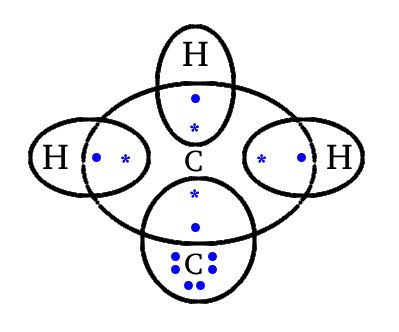
Carbon has four valence electrons. It shares 1 electron each with 3 hydrogen atoms and 1 electron with chlorine. The bond between C and Cl atoms is covalent, but due to high of electronegativity of Cl, the C-CI bond is polar in nature.
Q.5) How would you distinguish experimentally between an alcohol and a carboxylic acid?
Ans) We can distinguish between an alcohol and a carboxylic acid on the basis of their reaction with carbonates and hydrogen carbonates. Acid reacts with carbonate and hydrogen carbonate to evolve CO2 gas that turns lime water milky.
Metal carbonate/metal hydrogen carbonate + Carboxylic acid
↓
Salt + Water + Carbon dioxide
Alcohols, however, do not react with carbonates and hydrogen carbonates.
Q.6) Draw the electron dot structure of ethyne. A mixture of oxygen and ethyne is burnt for welding. Can you tell why a mixture of ethyne and air is not used?
Ans) 2HC ≡ CH + 502 → 4CO₂ + 2H₂O + Heat
When ethyne is burnt in air, it gives a sooty flame. This is due to incomplete combustion caused by limited supply of air. However, if ethyne is burnt with oxygen, it gives a clean flame with temperature of 3000°C because of complete combustion. This oxy-acetylene flame is used for welding. It is not possible to attain such a high temperature without mixing oxygen. This is the reason why a mixture of ethyne and air is not used.
Electron dot structure of ethyne (C₂H₂) is H:C:::C:H, and H-C ≡ C-H is its structural formula.
Q.7) What are the two properties of carbon which lead to a huge number of carbon compounds we see around us?
Ans) The two properties of carbon which lead to a large number of compounds are:
Catenation – It is the ability to form bonds with other atoms of carbon.
Tetravalency – With the valency of four, carbon is capable of forming bonds with four other atoms.
Q.8) When you add sodium hydrogen carbonate to acetic acid in a test tube, a gas liberates immediately with a brisk effervescence. Name this gas. Describe the method of testing this gas. Or
A student adds a spoon full of powdered sodium hydrogen carbonate to a flask containing ethanoic acid. List two main observations he must note in his notebook about the reaction that takes place. Also write chemical equation for the reaction.
Ans) Ethanoic acid or acetic acid reacts with sodium hydrogen carbonate to give sodium acetate, carbon dioxide and water.
CH₃COOH + NaHCO₃ → CH₃COONa + H₂O + CO₂
Observations:
- A gas is liberated with a brisk effervescence.
- When the gas which is liberated is passed through freshly prepared lime water, it turns it milky. This proves that the gas is carbon dioxide.
Q.9) Why are certain compounds called hydrocarbons? Write the general formula for homologous series of alkanes, alkenes and alkynes, and also draw the structure of the first member of each series. Write the name of the reaction that converts alkenes into alkanes and also write the chemical equation to show the necessary conditions for the reaction to occur.
Ans) Compounds which contain only carbon and hydrogen are called hydrocarbons. The saturated hydrocarbons are called alkanes. The unsaturated hydrocarbons are called alkenes, containing one or more double bonds. Those containing one or more triple bonds are called alkynes. The general formula for their homologous series are-
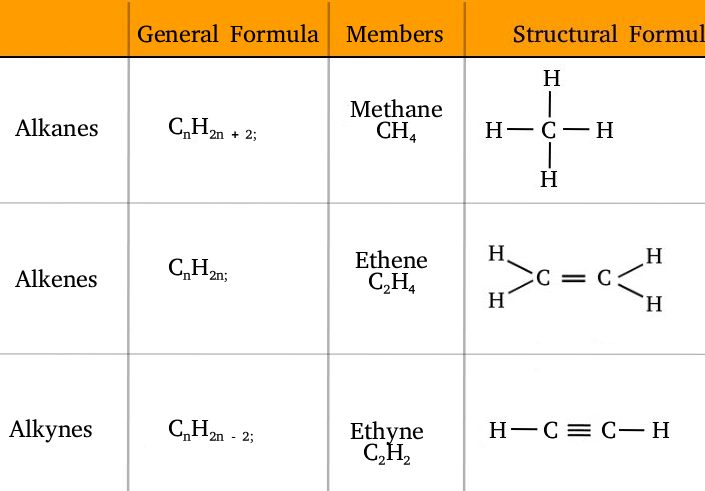
The reaction that converts alkenes into alkanes is a hydrogenation reaction. It involves the addition of hydrogen atoms. It converts unsaturated hydrocarbon to saturated hydrocarbon. The double bonds in alkenes are broken into single bonds in alkanes. The hydrogenation requires catalysts like nickel or Pt at a temperature around 423 K.
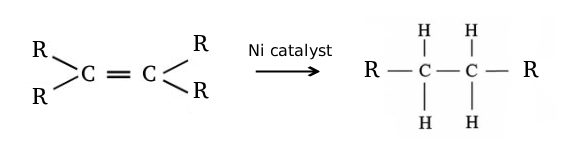
This reaction is commonly used in the hydrogenation of vegetable oils using a Ni catalyst.
Q.10) Write chemical equation of the reaction of ethanoic acid with the following (a) Sodium, (b) Sodium hydroxide, (c) Ethanol.
Ans) (a). Reaction of ethanoic acid with sodium.
CH₃COOH + Na → CH₃COONa (Sodium ethanoate) + H₂
Main product is sodium ethanoate.
(b) Reaction of ethanoic acid with sodium hydroxide gives a salt, sodium ethanoate, commonly called sodium acetate, and water.
CH₃COOH + NaOH → CH₃COONa (Sodium ethanoate) + H₂O
(c) Ethanoic acid reacts with absolute ethanol in the presence of an acid catalyst to give an ester.

Q.11) An aldehyde as well as a ketone can be represented by the same molecular formula, say C3H6O. Write their structures and name them. State the relation between them in the language of science.
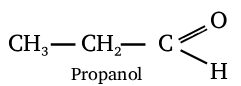
Ans) Since the molecular formula of aldehyde and ketone is same and their structural formulae are different, they are isomers.
Their chemical names are-
- Aldehyde- Propanal
- Ketone- Propanone
structural formula of Aldehyde:
structural formula of Ketone:
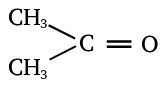
Propanone
Q.12) Write the structural formula of Ethanol. What happens when it is heated with excess of conc. H₂SO₄ at 443 K? Write the chemical equation for the reaction stating the role of conc. H₂SO₄ in this reaction.
Ans) The structural formula of Ethanol (CH₃-CH₂OH) is
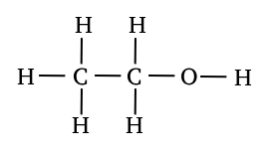
Heating ethanol at 443 K with excess conc. sulphuric acid results in the dehydration of ethanol to give ethene-
CH₃-CH₂OH → conc. H₂SO₄ → CH₂ = CH₂ + H₂O
Conc. Sulphuric acid (H₂SO₄) can be regarded as a dehydrating agent which removes water from ethanol.
Q.13) What is a homologous series? Explain with an example.
Ans) A homologous series is a series of carbon compounds that have different number of carbon atoms but contain the same functional group.
For example methane, ethane, propane, butane etc. are all parts of the alkane homologous series. The general formula of this series is CnH2n+2.
Methane (CH₄), ethane (C₂H₆), propane (C₃H₈), and butane (C₄H₁₀).
It can be noticed that there is a difference of -CH2 unit between each successive compound.
Q.14) What is hydrogenation? What is its industrial application? Or
Define hydrogenation and write its industrial applications.
Ans) Hydrogenation is the chemical reaction between hydrogen and other compounds in the presence of a catalyst. Hydrogenation is used mainly to reduce saturated hydrocarbons. It is an addition reaction. For example, when ethene is heated with a catalyst nickel, it is reduced to ethane.
Industrial Application: Hydrogenation is used in many industrial applications. For example, in petrochemical industry, hydrogenation is used to convert alkenes into alkanes (paraffins) and cycloalkanes. It is also used to prepare vegetable ghee from vegetable oils.
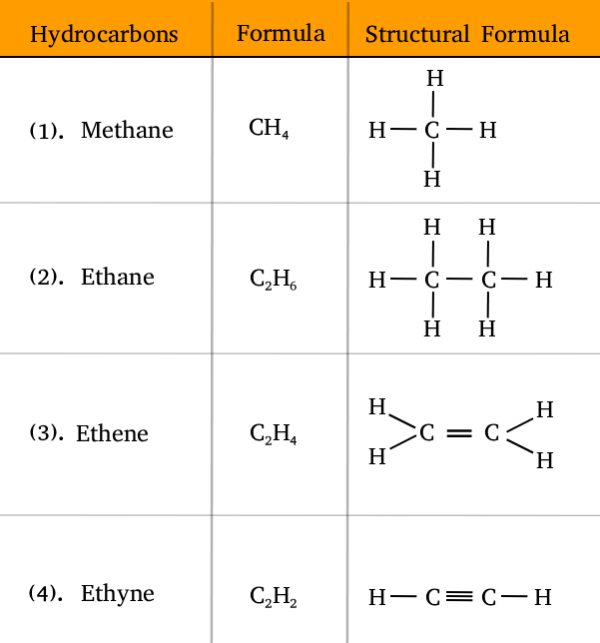
Q.15) Write the names, formula and structural formula of first four hydro-carbons.
Ans) Name, formula and structural formula of Hydrocarbon :
Q.16) Name the following compounds :
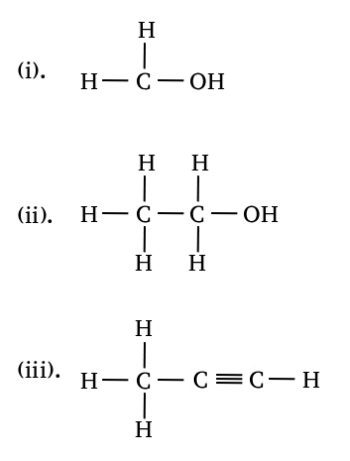
Ans) (1) Methanal, (ii) Ethanol, (iii) Propyne.